Golf Bag Structure: Club Tube Layout and Production Drawings
A golf bag engineered as a structure rather than a sewn shape — club tube geometry, opening transitions, handle mounting and drawings the textile manufacturer could quote from.
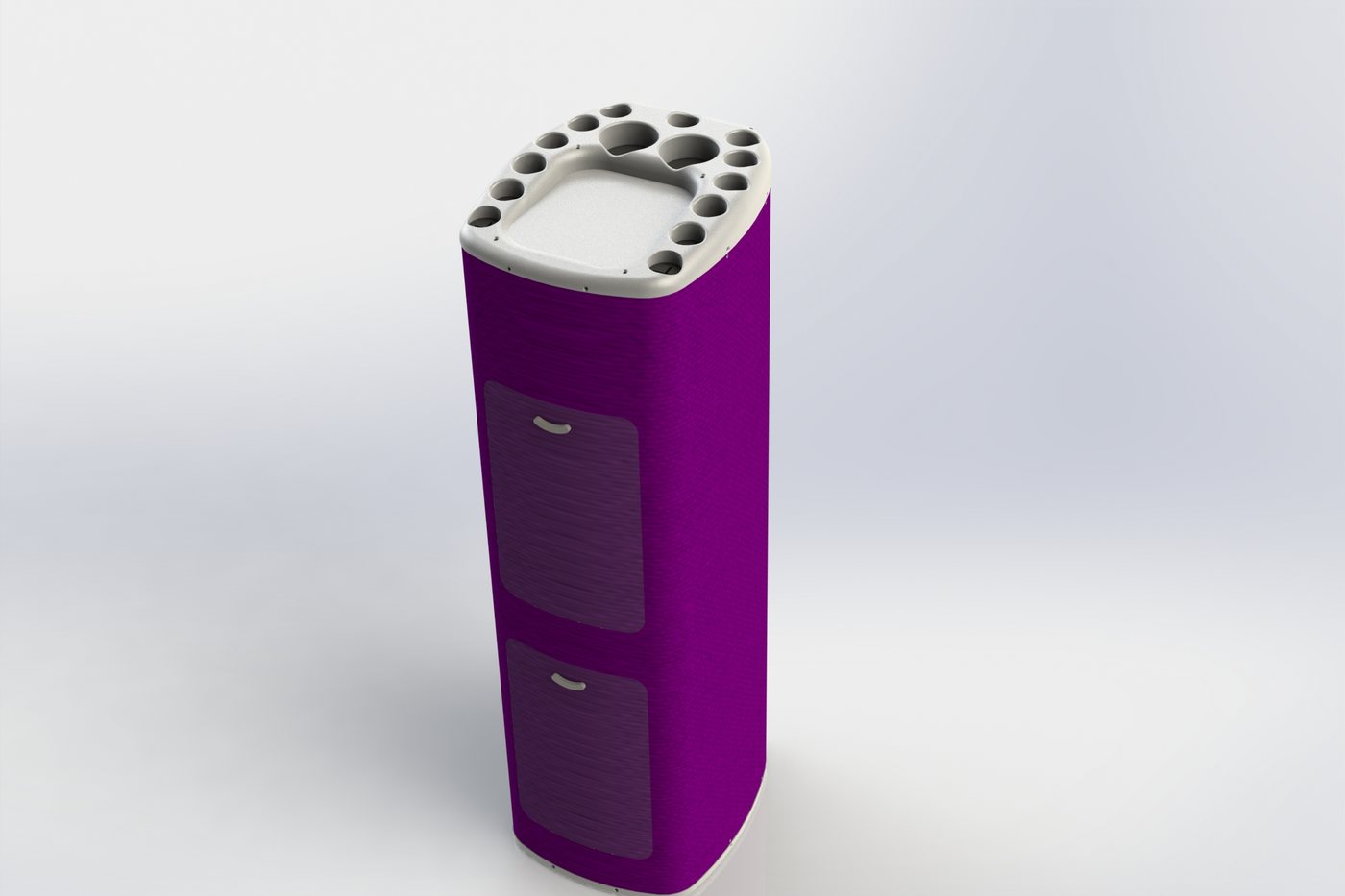
A golf bag looks like a sewn product. Structurally it is a rigid frame — a top cuff, a base, and a set of tubes that keep clubs apart — wrapped in fabric. The frame is where the design lives.
The problem
The brief looked simple and turned out to be dense with detail:
- Club tube layout. The tubes set how many clubs fit, how they separate, and whether the bag stays upright when it is half empty.
- The opening transition. Square openings suit the bag’s boxy styling, but a square edge over a round tube gives an unpleasant catch every time a club is dropped in — a detail the user feels a hundred times a round.
- Handles top and bottom had to mount into the structure, not into fabric.
- Fabric cannot be modelled meaningfully. Textures and weave belong to the textile supplier, not to a CAD model — but the manufacturer still needs to be told what goes where.
The approach
- Structure first, skin second. Top cuff, tube array and base designed as a load path so the bag holds shape whether full or nearly empty; the fabric is then detailed onto it.
- Opening geometry resolved with the client. The trade-off between styling and feel was put on the table explicitly, with the rubber shaft-fixation layer between tube and opening taken into account before the shape was fixed.
- Handles mounted to hard points integrated into the frame rather than stitched to the shell.
- Notes where models cannot go. Fabric structure and pattern specified as drawing notes for the textile supplier to satisfy, with the brand name and logo placed on the front panel.
The result
Nine design iterations — a heavily revised project — ending in a complete structural model and a production drawing package covering both the rigid parts and the instructions the textile manufacturer needed.
Where this applies
Products that sit between hard goods and soft goods: bags, cases, carriers, protective gear. Someone has to own the boundary between the frame and the fabric, and it is usually the mechanical designer.
I design consumer products for production — structure, moulded parts and the drawing package for hard and soft components alike. Request a quote or see all services.