Scissor-Lift Mechanism with Clamp Mounting
A compact scissor linkage designed for stable lift and a clamp interface — link geometry, pivot loading and fastener selection worked out and drawn for manufacture.
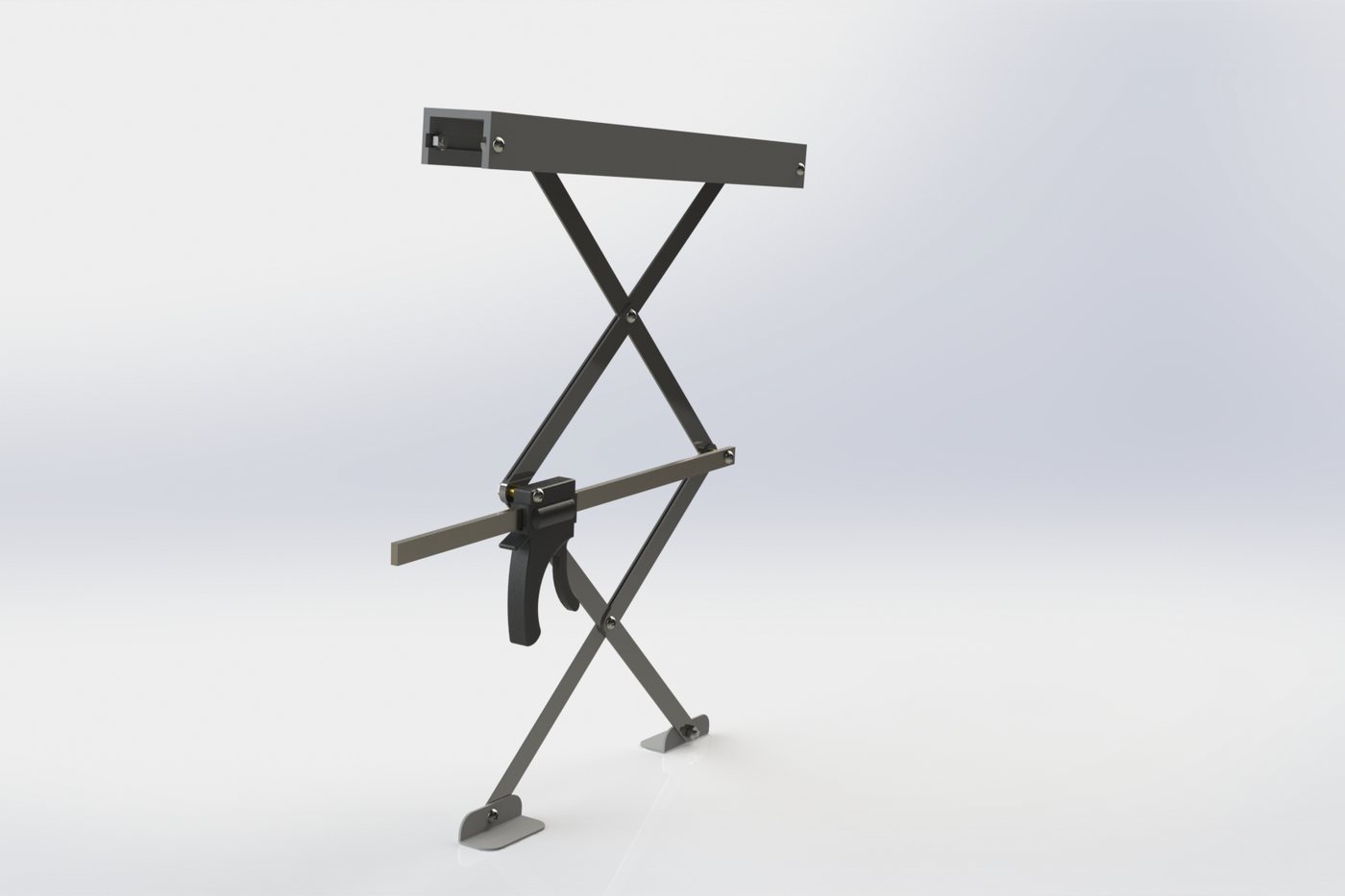
A scissor linkage looks like the simplest mechanism in engineering, right up until it has to be compact, stable and cheap at the same time.
The problem
In a scissor lift, one geometric choice sets everything else:
- Link length and pivot spacing determine the lift ratio — and how the force needed changes through the stroke. Get it wrong and the mechanism is heavy at the bottom and unstable at the top.
- Pivot loads peak when the linkage is nearly flat, exactly where most designs are thinnest.
- Lateral stiffness is the failure mode users notice: a lift that rises correctly but wobbles sideways feels broken even when it is safe.
- The assembly also needed a clamp so the unit could attach to whatever it was mounted on.
The approach
- Geometry sized from the stroke, not the envelope. Link lengths were set by the required travel and the force curve, then the enclosure was fitted around the result.
- Pivots sized for the flat position, the worst case, rather than for the mid-stroke condition that looks reasonable in a render.
- Standard fasteners throughout — hex nuts and round-head screws from catalogue sizes, so the assembly can be built and serviced without special hardware.
- Two build iterations, with the second version carrying the full drawing set part by part.
The result
A complete scissor mechanism with clamp interface, modelled as an assembly and documented with per-part production drawings.
Where this applies
Lifts, stands, folding supports and any linkage that has to raise a load smoothly through its whole stroke. The engineering is in the link geometry — everything visible is downstream of it.
I design mechanisms and machine elements, with drawings a shop can build from. Request a quote or see all services.