Sleep Mask with an Integrated Nasal Dilator Arch
A premium sleep mask that looks ordinary from outside and carries a carbon nasal arch inside — magnets aligned to adhesive nasal strips, drawn in three sizes.
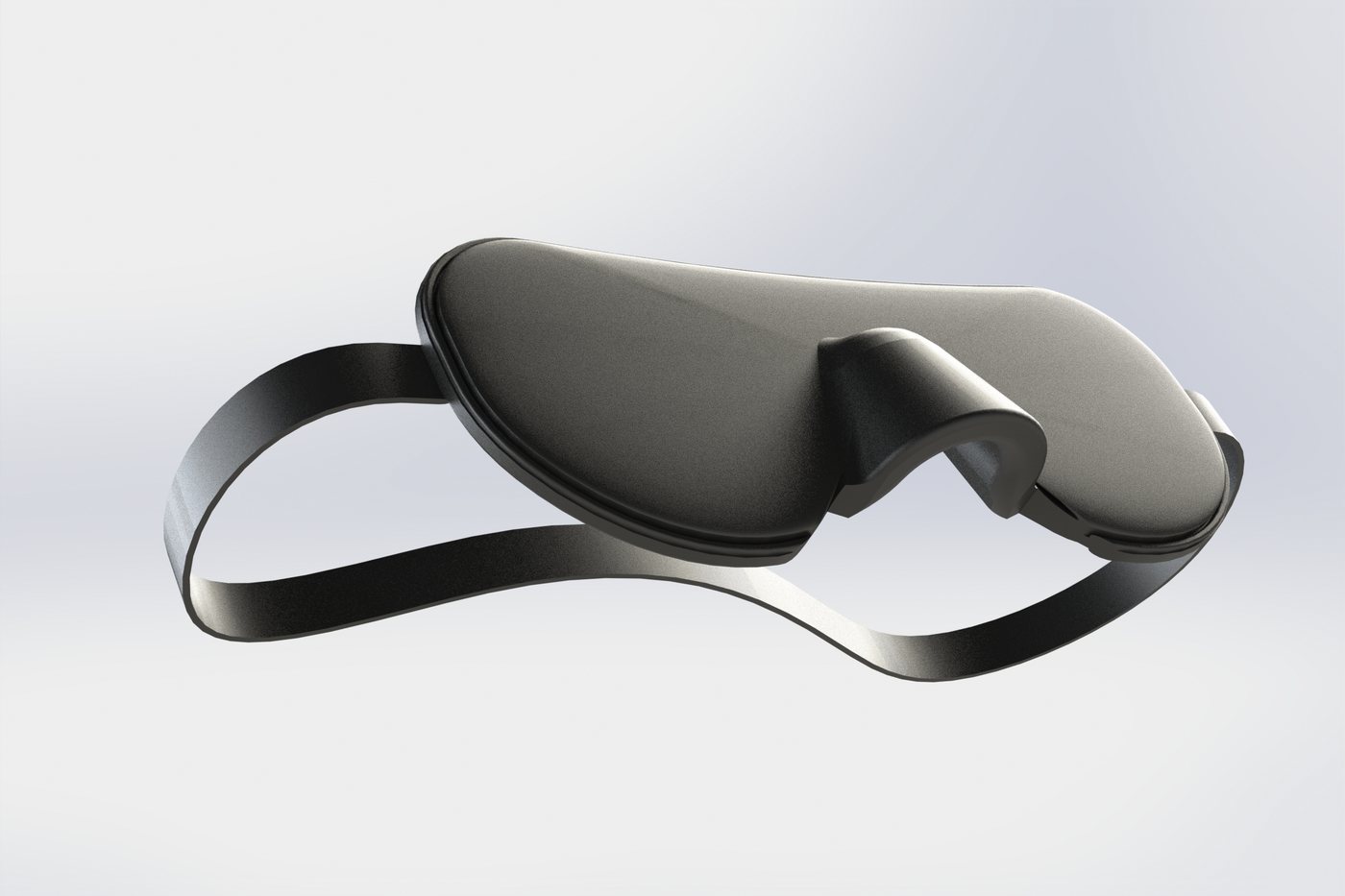
The client’s product is not the mask. It is what the mask hides: a nasal dilator that improves airflow while you sleep, integrated so completely that from the outside it looks like an ordinary silk sleep mask.
The problem
- The core feature is invisible. A U-shaped carbon arch sits at the nose bridge, working with small magnetic nasal stickers that gently open the nostrils. It has to be inside the mask without showing through.
- Magnets have to align with adhesive strips worn on the face — so their position in the fabric is a functional dimension, not a placement choice.
- The mask itself is textile. Curved, soft, sewn — not goggles, and explicitly not a redesign of a sleep mask.
- The arch needed its own sizes. The client wanted the nasal clip drawn in S, M and L, because it might be manufactured separately from whoever sews the masks.
Mid-project the client pointed out the critical omission directly: the drawings showed a good base mask, but the internal arch — the entire reason the product exists — was missing from the documentation.
The approach
- Build the mask CAD first, then integrate. Production drawings cannot be sourced from an outside mockup; the base geometry had to exist as a model before the arch could be placed correctly inside it.
- A cross-section as a primary deliverable, because the arch cannot be seen in any external view — the section is the only drawing that proves the feature is there.
- Magnet positions dimensioned to the face, tied to where the nasal strips sit rather than to the mask’s own outline.
- Stitch types specified in the 2D drawings, so the manufacturer receives instructions rather than interpretations.
- Three clip sizes documented separately, letting the client dual-source the rigid part and the textile part.
The result
A full drawing package: base mask, integrated nasal arch, cross-sections, stitch specification and the clip in three sizes — developed through five iterations including a late revision round.
Where this applies
Wearables that combine textile and rigid components, where the functional part is hidden. Sections and dimensioned positions do the work no render can.
I document soft goods and hybrid products so manufacturers can build them without guessing. Request a quote or see all services.