Tactical Glove Assembly Drawing for Overmoulded Protection
A manufacturing drawing showing where polycarbonate plates and cast silicone go on a base glove — the document a textile factory needs when the CAD stops at the fabric.
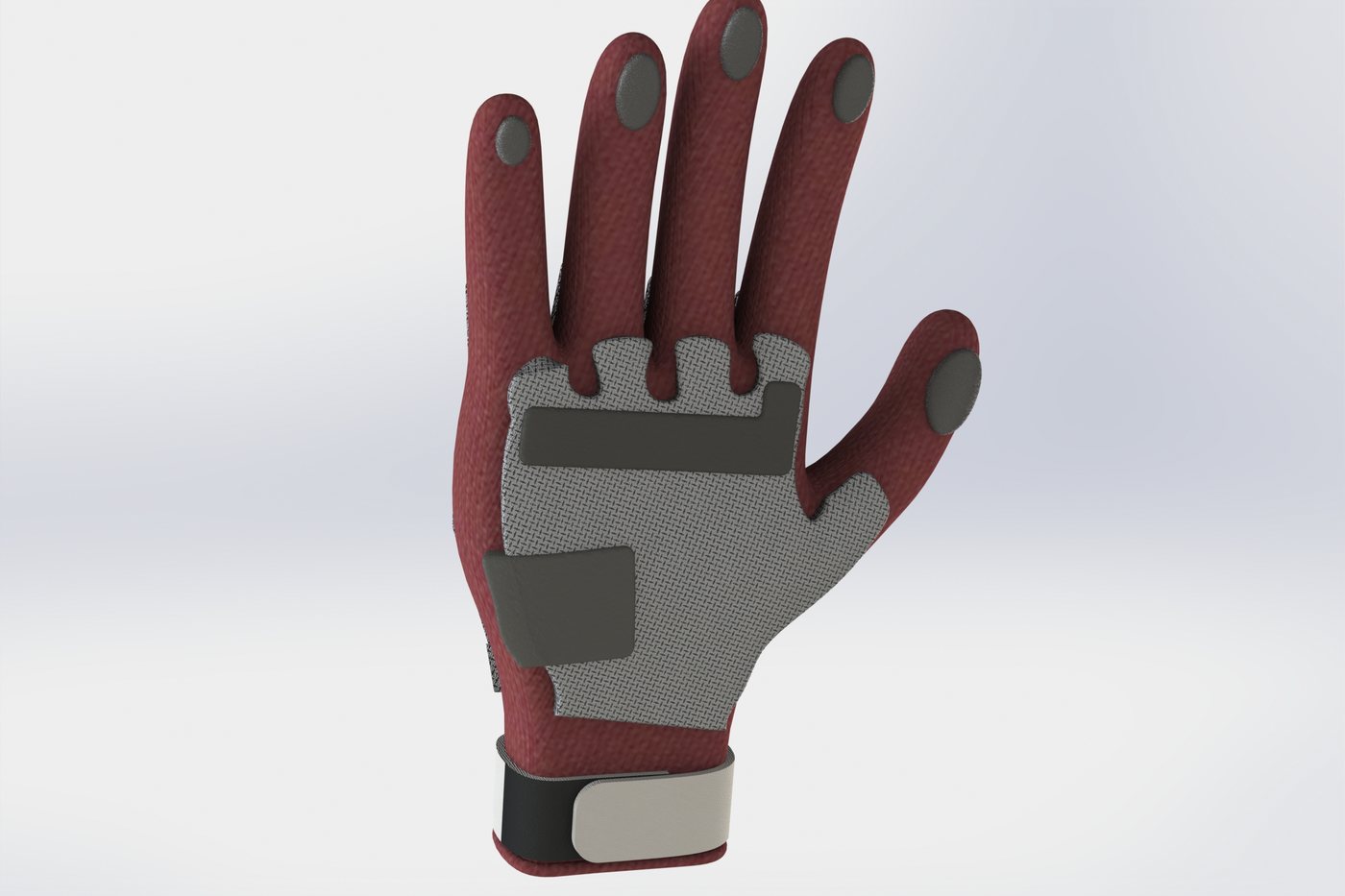
The client did not need a glove designed. They needed a drawing that told a factory exactly where to put the hard parts on a glove that already exists.
The problem
This is a documentation job with a boundary that has to be drawn correctly:
- The base glove is pre-manufactured. The factory has a standard model; the drawing describes what is added to it, not how it is knitted.
- Seams and knit structure belong to textile engineers, not to a mechanical drawing — trying to document them here would produce a drawing nobody can follow.
- The silicone is cast directly onto the glove, not made separately and glued, which changes what the drawing must communicate: position and boundary, not a part outline.
- Glove thickness varies across the hand, so a flat 2D reference cannot simply be scaled to place three-dimensional protection.
- Polycarbonate plates on the back needed their outline and coverage defined from a two-dimensional reference that did not carry heights.
The approach
- Scope agreed before drawing. The questions came first: are seams shown, is silicone cast or bonded, is the glove pre-made — because each answer changes the entire document.
- Positions defined against hand landmarks, so the drawing stays valid across the thickness variation instead of depending on a nominal that does not exist.
- Detail and texture where it earns its place — the client needed the drawing to be detailed and textured for review, so the render and the technical document were produced from the same model.
- Coverage boundaries as the deliverable, since with cast-on silicone the factory needs to know where material starts and stops, not a separate part geometry.
The result
A detailed assembly drawing and 3D files defining plate and silicone placement, delivered for the client’s factory review.
Where this applies
Protective equipment and hybrid textile products where rigid or moulded elements are added to a soft base. The value is in knowing which drawing to produce — and which to leave to the textile engineers.
I produce manufacturing documentation for hybrid soft-and-hard products. Request a quote or see all services.