Vacuum-Insulated Dual Vessel for a Thermal Battery System
Two stacked stainless double-wall vacuum vessels with passive heat pipes and a PCM thermal store — every penetration sealed, every wall detailed for weld and vacuum integrity.
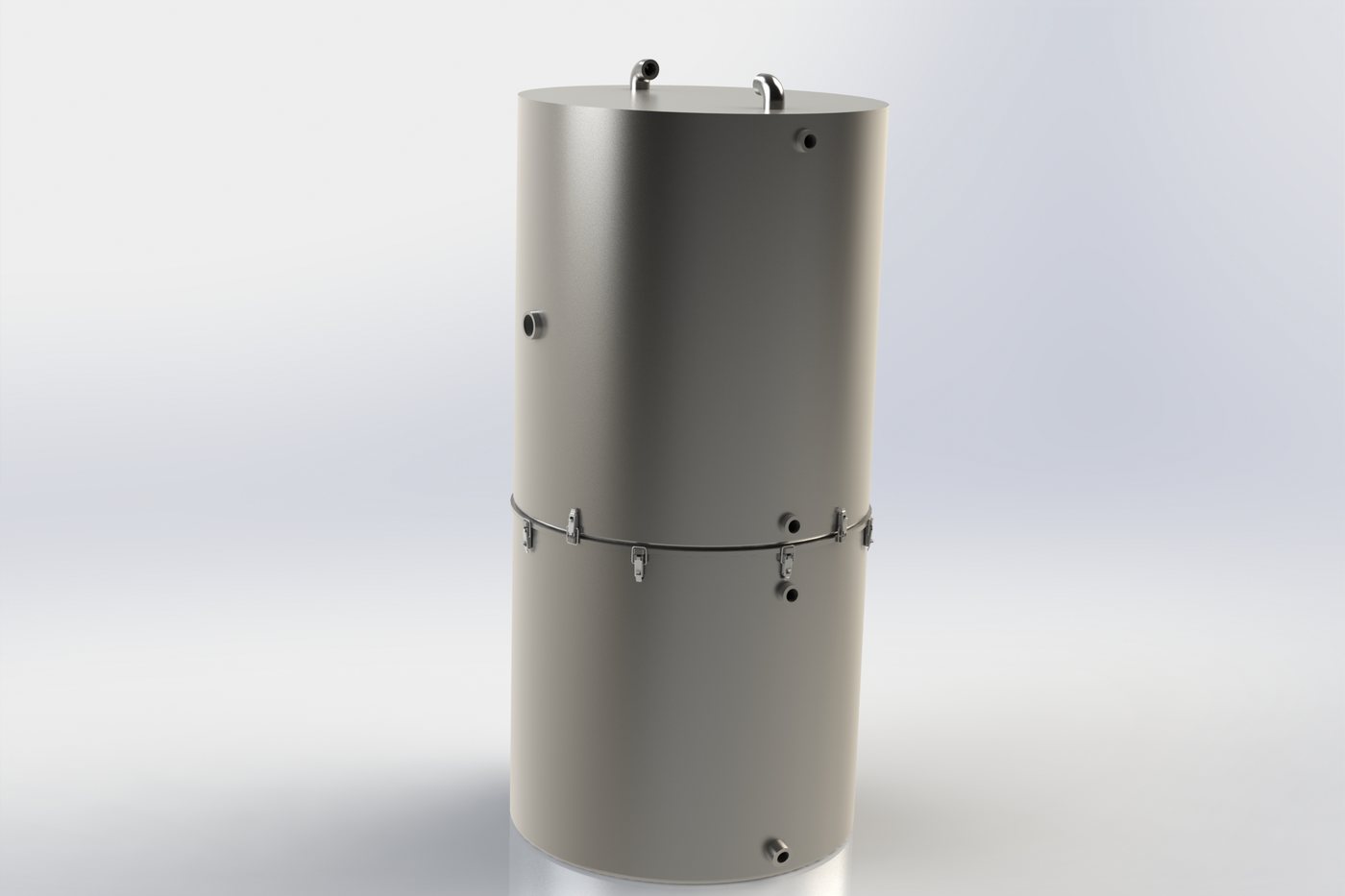
A client developing a thermal battery needed the hardest part of it engineered: two stacked, double-wall, vacuum-insulated stainless vessels that had to hold vacuum, transfer heat, and still be manufacturable by a fabrication shop.
The problem
The system stores heat in a phase-change material and gives it back to municipal water through a passive coil circuit. That put three demands on the vessels at once:
- Vacuum integrity. Every penetration — ports, heat pipes, the lid — had to stay sealed for the life of the unit, with no maintenance access.
- Deliberate heat paths. Eight passive heat pipes had to carry heat from the lower vessel into the upper one, while the vacuum jacket blocked heat everywhere else. Insulation and conduction had to coexist centimetres apart.
- A shop had to build it. Roughly 24″ diameter and 28″ tall per vessel, in stainless — the design had to suit welding and brazing, not a machining centre.
The approach
- Dimpled inner wall instead of spacer rings. The inner wall carries dimples inset toward the outer wall, so each dimple face becomes a weld point that ties the two walls together without a continuous thermal bridge.
- Low-conductivity vacuum supports. Ceramic/polymer standoffs hold the 0.75″ vacuum gap during assembly without shorting it thermally.
- Serviceable vacuum charging. A vacuum port on the lower vessel, the upper vessel and the lid — the same logic as an HVAC charging port — so the jacket can be pulled down and re-charged later.
- Heat exchange defined as hardware. A five-coil passive water loop plus eight copper heat pipes, rounded at the bottom and pinched at the top, with a modified tri-clamp joint and toggle clamps between the two vessels.
Before modelling started, the brief was pushed back on: what thermal performance is the target, which way do the dimples face, what seals the lid, what holds the gap. Those answers are what made the model buildable rather than merely plausible.
The result
A complete CAD set for both vessels, the heat pipe array, the sealing details and the clamping hardware — delivered through four design iterations as the client’s thermal concept firmed up around it.
Where this applies
Vessels, jackets, tanks and any assembly where sealing, heat transfer and weldability fight each other. The design work is deciding which one loses, where, and by how much.
I design pressure and vacuum vessels, weldments and thermal hardware in SolidWorks, with drawings a fabrication shop can quote from. Request a quote or see all services.