Slim Wallet Insert: Injection-Moulded Case, Hinge and Snap-Fit in 10 mm
A tracker compartment engineered into a slim leather wallet — mechanical pin hinge over living hinge, ABS over PP, 1.5 mm walls, plus the stitching drawings for the leather body.
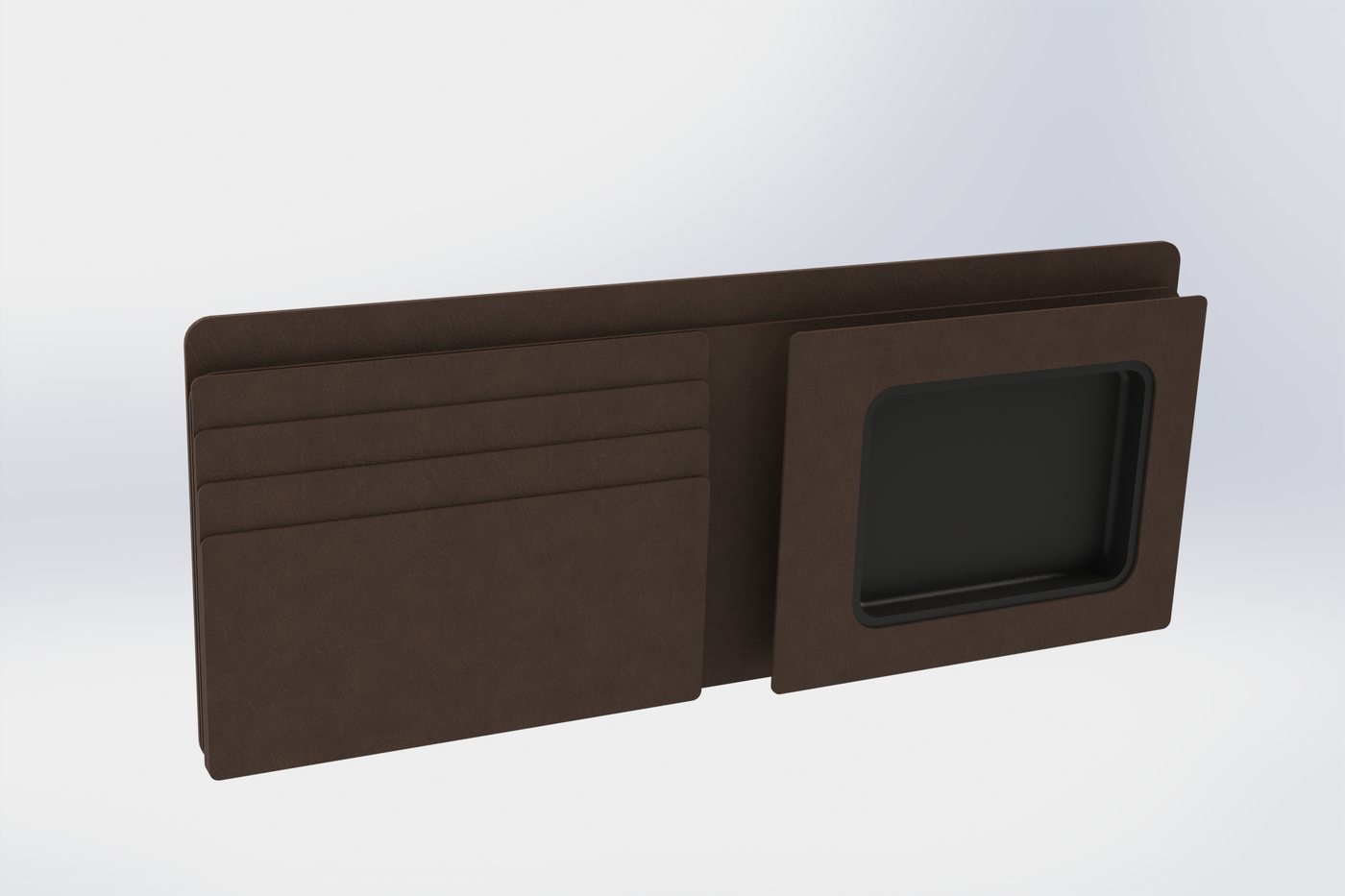
A slim bifold wallet with a hidden compartment for a tracker. The whole product had a 10 mm thickness budget, and the compartment — case, lid, hinge and latch — had to live inside it and still survive being opened every day.
The problem
Thin sections punish every easy choice:
- A living hinge is the obvious answer in moulded plastic — and the wrong one here. At this wall thickness it fatigues long before the wallet wears out.
- A snap-fit has to hold the lid closed securely, open with one hand, and not wear loose after a few hundred cycles. Those three pull in different directions.
- Wall thickness versus cavity volume. Every tenth of a millimetre given to strength is taken from the space the tracker needs.
- The insert also had to disappear into the leather — flush, no bulge, clean edges — which made the leather body part of the same engineering problem.
The approach
- Mechanical hinge, 1 mm steel pin. Chosen over a living hinge specifically for cycle life in a slim section; the pin carries the duty the plastic cannot.
- ABS over PP. Rigidity and dimensional stability for the housing, with the hinge duty moved to the metal pin instead of the polymer.
- 1.5 mm nominal wall, reinforced locally. Ribs and local thickening placed where the load is, so stiffness comes from geometry rather than from adding thickness everywhere.
- Leather drawn the way leather is made. Fold areas modelled flat — standard practice so the manufacturer can measure directly — with stitch lines, allowances and assembly notes carried in the 2D drawings.
The result
A production-ready package: STEP for the injection mould, STL for prototype printing, and 2D technical drawings covering both the plastic insert and the leather body — refined across five iterations as the client’s brief evolved.
Where this applies
Small moulded parts with a thickness ceiling and a daily-use duty cycle: closures, cases, latches, wearables. The design decisions worth paying for are the ones made before the first surface is drawn.
I design injection-moulded parts for tooling — DFM, wall sections, snap-fits and the drawing package. Request a quote or see all services.